
Blog
13 July 2026
How Translatomics Is Reshaping RNA Therapeutics
RNA therapeutics have moved beyond the question of whether an RNA molecule can be designed, delivered, and stabilized. The bigger question now is whether that RNA actually performs its intended function inside the cell. For mRNA therapeutics, that means asking whether the transcript engages ribosomes and produces the intended protein. For other RNA-based approaches, the mechanism can run in the opposite direction. Therapeutics such as small interfering RNAs and antisense oligonucleotides often act on the target RNA itself, changing its stability or triggering its degradation before it is translated.1 Evaluating these treatments means following both the fate of the target and the changes they produce in the cell's translational output.
This is where translatomics becomes important. Instead of measuring only RNA abundance, translatomics examines the active layer of gene expression: ribosome engagement, translation efficiency, ribosome occupancy, and codon-level behavior.2,3 It also brings tRNA abundance, modification status, and decoding context into view.4 This helps explain why two RNA designs with similar abundance may produce very different biological outcomes.2,5
For RNA therapeutic teams, translation-level data is becoming a practical decision layer. It can support candidate selection, sequence optimization, mechanism-of-action studies, formulation comparison, and cell-context evaluation. At Immagina Biotechnology, we help researchers investigate this functional layer through ribosome profiling, active ribosome analysis, nano-tRNAseq, and Ribo-tRNAseq.
Why RNA therapeutics need translation-level evidence
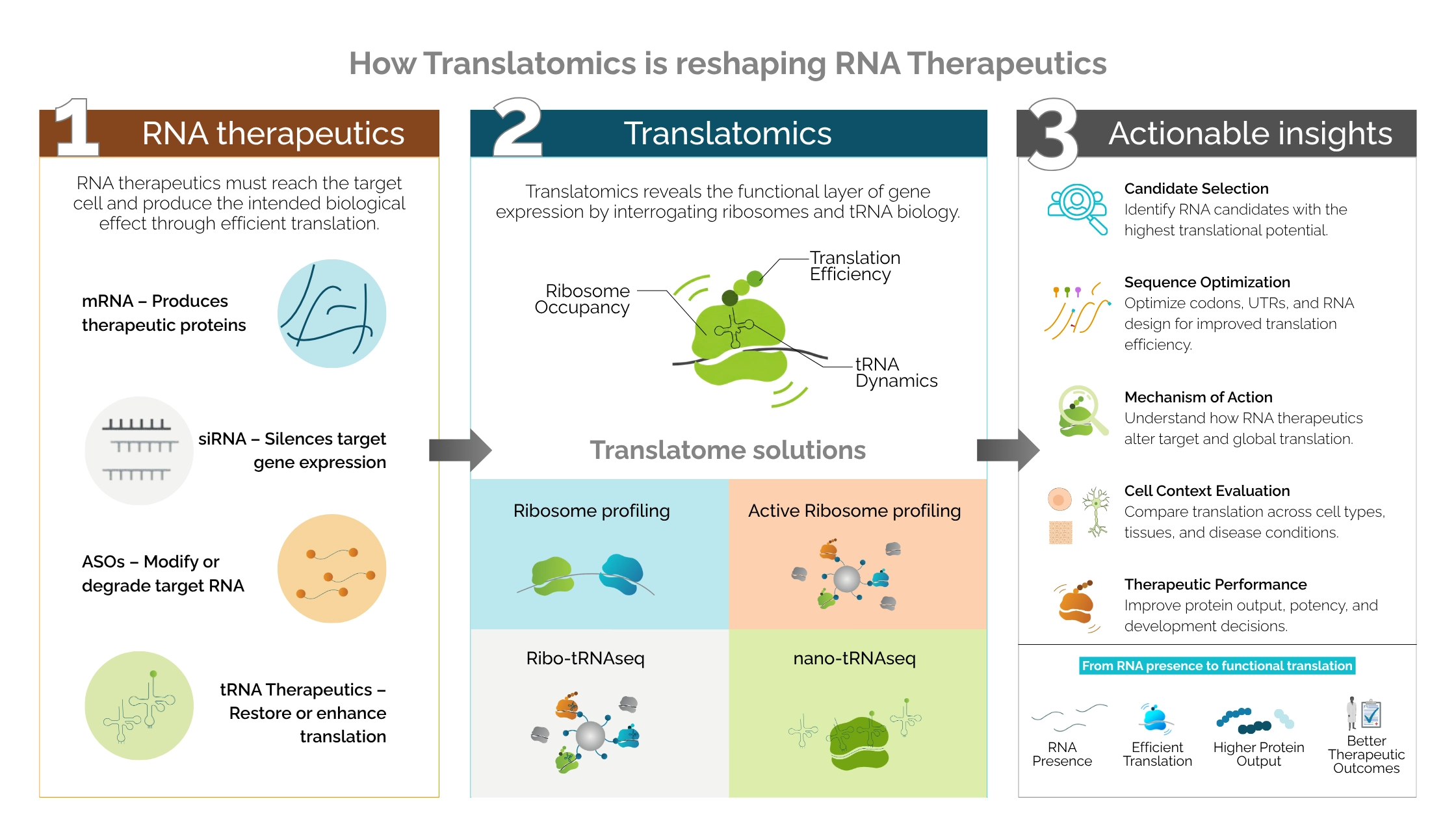
To exert its therapeutic effect, an RNA therapeutic must reach the appropriate compartment, remain intact, interact with the appropriate machinery, and produce the desired downstream effect. For mRNA therapeutics, that downstream effect is a protein, so it matters whether the therapeutic transcript is not only present but translated efficiently. For approaches whose therapeutic RNA is not itself translated, such as antisense oligonucleotides and small interfering RNAs,1 the question shifts to how the treatment changes the translation of its target and of the wider transcriptome. Traditional transcriptomics can show which transcripts are present, but it does not show which of them are actually being translated.
A transcript can be abundant but poorly translated.2 A therapeutic mRNA can be delivered successfully but still produce weak protein output if translation initiation, codon usage, UTR design, RNA structure, or cellular context are not aligned.5-8 This distinction matters because modern mRNA design already recognizes that stability, immunogenicity, and translation efficiency are connected.5,6,9
For therapeutic development, this means translation efficiency should not be treated only as a final confirmation step.2,5,7 It can guide early decisions by helping researchers compare sequence variants, UTR designs, codon strategies, and formulation conditions before moving into more expensive development stages.5,7,10,11
Ribosome profiling connects RNA design to protein output
Ribosome profiling, also known as Ribo-seq, gives researchers a direct view of ribosome-protected mRNA fragments.2 It shows which transcripts are actively translated and where ribosomes are positioned across the coding sequence.2 For RNA therapeutics, this can answer practical questions: Is the therapeutic mRNA being translated? Are ribosomes moving as expected? Are there signs of ribosome pausing, altered initiation, or unexpected translation events?2,5
The payoff of designing from translation data rather than sequence heuristics is becoming concrete. In one recent study, a model trained on ribosome profiling measurements across two dozen human tissues and cell types was used to redesign the coding sequences of therapeutic mRNAs. The redesigned influenza vaccine candidate raised neutralizing antibody titers roughly tenfold over the unoptimized sequence in mice, and a redesigned nerve growth factor mRNA reached equivalent neuroprotection at one-fifth the dose.5
Immagina's ribosome profiling service supports translational regulation studies by providing insight into ribosome occupancy and translation efficiency.2 Immagina also offers active ribosome profiling using RiboLace technology, which captures actively translating ribosomes.3 This can help researchers focus on productive translation rather than broad ribosome association.3
Need to compare mRNA
candidates beyond RNA abundance?
Talk to Immagina about standard and active ribosome profiling for translation efficiency analysis.
Why tRNA biology matters in RNA therapeutics
Translation does not depend solely on mRNA and ribosomes. It also depends on tRNAs, codon decoding, tRNA abundance, and tRNA modifications.4,12,13,14 This is especially important as tRNA therapeutics emerge as a new area of RNA medicine.12,13 These therapies act directly through the translation machinery, so understanding tRNA behavior is essential.12,13
For mRNA therapeutics, tRNA biology also matters because codon usage is interpreted through the available tRNA pool.4,14 A sequence that looks optimized in silico may behave differently across cell types, stress states, or disease contexts.5,14 By adding tRNA-level analysis, researchers can better understand the cellular decoding environment that shapes therapeutic performance.4,14
The size of this effect can be substantial. In one study, supplying the tRNAs that matched the most-used codons of a SARS-CoV-2 Spike mRNA raised Spike protein output by up to 4.7-fold with no change to the mRNA sequence, and ribosome profiling confirmed the higher ribosome occupancy behind it.14 The codon sequence stayed constant throughout, and what changed was the decoding capacity available to read it.
nano-tRNAseq and Ribo-tRNAseq add functional depth
tRNAs are difficult to study because they are short, structured and heavily modified.4 nano-tRNAseq helps profile full-length native tRNAs, supporting analysis of both abundance and modification status.4 This gives researchers a clearer view of the tRNA pool available in the cell.4
Ribo-tRNAseq goes one step further by focusing on tRNAs actively engaged by translating ribosomes.3,4 Immagina's Ribo-tRNAseq workflow combines RiboLace pulldown technology with full-length native tRNA sequencing using Oxford Nanopore.3,4 This helps researchers understand which tRNAs are actually being used during active translation.3,4
For RNA therapeutic programs, this creates a more functional view of translation.2,4 Researchers can ask whether a therapeutic condition change ribosome-associated tRNAs, whether specific tRNA isoacceptors are enriched, and whether codon usage strategies align with the tRNA pool used during protein synthesis.4,14
Where Translatomics can improve RNA therapeutic development
Translatomics can support RNA therapeutic research across several stages of development.2,5,7 It can help compare early candidates, evaluate UTR and coding sequence designs, understand cell-type-specific performance, interpret dose and potency, and study the mechanism of action.2,5,7 For tRNA therapeutics, it can also show how engineered or therapeutic tRNAs interact with the endogenous translation system.12,13,15
The key shift is simple: RNA therapeutic development is moving from asking "Is the RNA there?" to asking "Is the RNA doing what it is supposed to do?"2,6 That second question is where ribosome profiling, active ribosome analysis, and tRNA sequencing become especially valuable.2-4
Conclusion
RNA therapeutics are built on the promise that RNA can direct, correct, or reshape biology.6,12,13 To evaluate that promise, researchers need to understand the translation layer with precision.2,5 RNA abundance is important, but it is not the same as productive translation.2
Translatomics is reshaping RNA therapeutics by bringing this functional layer into view.2,3 It helps researchers see which RNAs are actively translated, how efficiently they engage ribosomes, how sequence design affects protein output, and how tRNAs participate in the process.2,4,5,14 At Immagina Biotechnology, we support researchers studying RNA function at the level where therapeutic effect truly happens: translation.
Ready to study how your RNA therapeutic candidate performs at the translation level?
Contact Immagina BioTechnology to discuss ribosome profiling, active ribosome analysis, nano-tRNAseq, or Ribo-tRNAseq for your next study.
References
1. Zhu Y, Zhu L, Wang X, Jin H. RNA-based therapeutics: an overview and prospectus. Cell Death & Disease. 2022;13(7):644. https://doi.org/10.1038/s41419-022-05075-2
2. Tomuro K, Iwasaki S. Advances in ribosome profiling technologies. Biochemical Society Transactions. 2025;53(3):555-564. https://doi.org/10.1042/BST20253061
3. Clamer M, Tebaldi T, Lauria F, et al. Active ribosome profiling with RiboLace. Cell
Reports. 2018;25(4):1097-1108. https://doi.org/10.1016/j.celrep.2018.09.084
4. Lucas MC, Pryszcz LP, Medina R, et al. Quantitative analysis of tRNA abundance
and modifications by nanopore RNA sequencing. Nature Biotechnology.
2024;42(1):72-86. https://doi.org/10.1038/s41587-023-01743-6
5. Li Y, Wang F, Yang J, et al. Deep generative optimization of mRNA codon
sequences for enhanced mRNA translation and therapeutic efficacy. Nature
Communications. 2025;16(1):9957. https://doi.org/10.1038/s41467-025-64894-x
6. Jia L, Qian SB. Therapeutic mRNA engineering from head to tail. Accounts of Chemical Research. 2021;54(23):4272-4282. https://doi.org/10.1021/acs.accounts.1c00541
7. Castillo-Hair S, Fedak S, Wang B, et al. Optimizing 5'UTRs for mRNA-delivered gene editing using deep learning. Nature Communications. 2024;15(1):5284. https://doi.org/10.1038/s41467-024-49508-2
8. Lewis CJT, Xie LH, Bhandarkar SM, et al. Quantitative profiling of human
translation initiation reveals elements that potently regulate endogenous and
therapeutically modified mRNAs. Molecular Cell. 2025;85(2):445-459. https://doi.org/10.1016/j.molcel.2024.11.030
9. Leppek K, Byeon GW, Kladwang W, et al. Combinatorial optimization of mRNA
structure, stability, and translation for RNA-based therapeutics. Nature
Communications. 2022;13(1):1536. https://doi.org/10.1038/s41467-022-28776-w
10. Zhang L, More KR, Ojha A, et al. Effect of mRNA-LNP components of two
globally-marketed COVID-19 vaccines on efficacy and stability. npj Vaccines.
2023;8(1):156. https://doi.org/10.1038/s41541-023-00751-6
11. Kim JG, Xu J, Lee D, et al. Comprehensive engineering of ionizable lipid
nanoparticles and mRNA elements for next-generation vaccines. ACS Nano.
2026;20(8):7022-7045. https://doi.org/10.1021/acsnano.5c19036
12. Coller J, Ignatova Z. tRNA therapeutics for genetic diseases. Nature Reviews
Drug Discovery. 2024;23(2):108-125. https://doi.org/10.1038/s41573-023-00829-9
13. Ward C, Beharry A, Tennakoon R, et al. Mechanisms and delivery of tRNA
therapeutics. Chemical Reviews. 2024;124(12):7976-8008. https://doi.org/10.1021/acs.chemrev.4c00142
14. Dong L, Wang J, Xia Q. Chemically modified tRNA enhances the translation
capacity of mRNA rich in cognate codons. Nature Communications.
2025;16(1):7825. https://doi.org/10.1038/s41467-025-62981-7
15. Pierce SE, Erwood S, Oye K, et al. Prime editing-installed suppressor tRNAs for
disease-agnostic genome editing. Nature. 2025;648(8092):191-202. https://doi.org/10.1038/s41586-025-09732-2